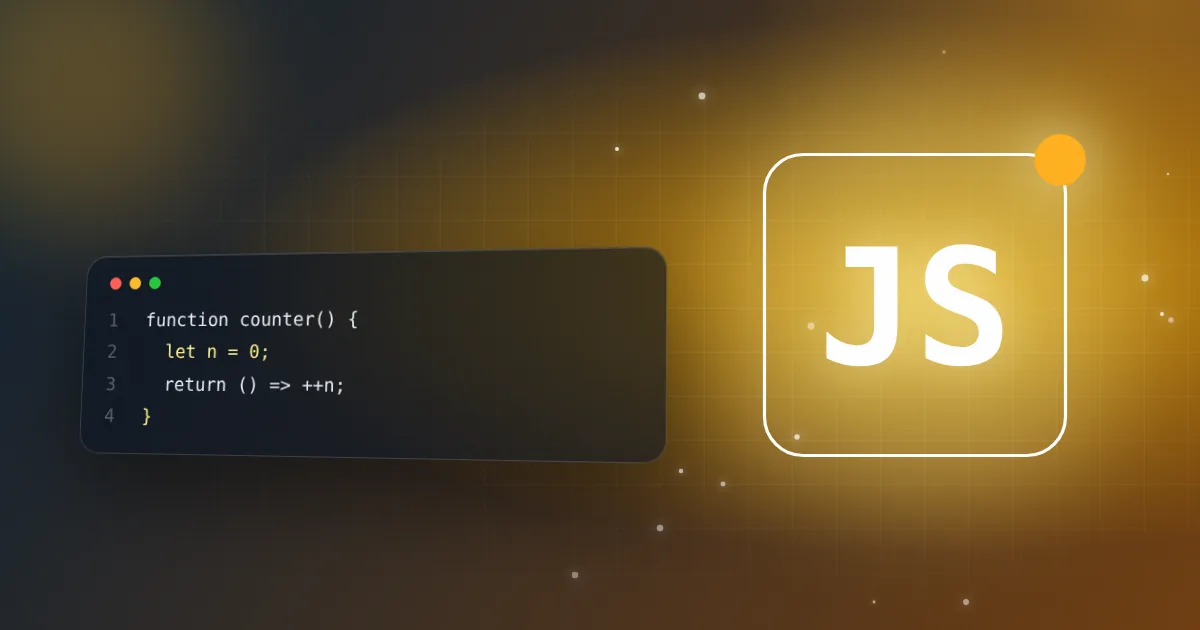
What is a closure?
A closure is a function that remembers the variables from the scope where it was created, even after that scope has finished.
function counter() {
  let n = 0;
  return () => ++n;
}
const next = counter();
next(); // 1
next(); // 2
Why does a var loop with setTimeout print the same number?
var is function-scoped, so every callback shares one variable. Use let, which creates a new binding per iteration.
How does the event loop work?
JavaScript runs one task at a time on the call stack. Async callbacks wait in queues. When the stack is empty, the loop runs all microtasks (promises) first, then the next macrotask (timers, events).
console.log(1);
setTimeout(() => console.log(2), 0);
Promise.resolve().then(() => console.log(3));
console.log(4); // 1, 4, 3, 2
What is the difference between == and ===?
== coerces types before comparing. === does not. Prefer ===.
Example: write a debounce function
function debounce(fn, delay) {
  let timer;
  return (...args) => {
    clearTimeout(timer);
    timer = setTimeout(() => fn(...args), delay);
  };
}

const onSearch = debounce((q) => console.log("search", q), 300);
This is a closure in practice: timer lives on between calls.
Example: run promises in parallel
const [user, posts] = await Promise.all([
  fetch("/api/user").then((r) => r.json()),
  fetch("/api/posts").then((r) => r.json()),
]);
Awaiting them one after another would take the sum of both times. Promise.all takes only the longer one.
Example: fix the loop
for (let i = 0; i < 3; i++) setTimeout(() => console.log(i), 0); // 0 1 2
Related resources
Keep practicing
Follow the topic-by-topic checklist and turn what you read into interview-ready answers.
Keep reading
Tailwind CSS interview questions and answers
Utility-first CSS, responsive design, dark mode and customization: what interviewers actually ask.
5 min read · Oct 27, 2026
GSAP interview questions: timelines, ScrollTrigger and React
The GSAP concepts frontend interviews cover, and how to use them correctly in React and Next.js.
5 min read · Oct 24, 2026